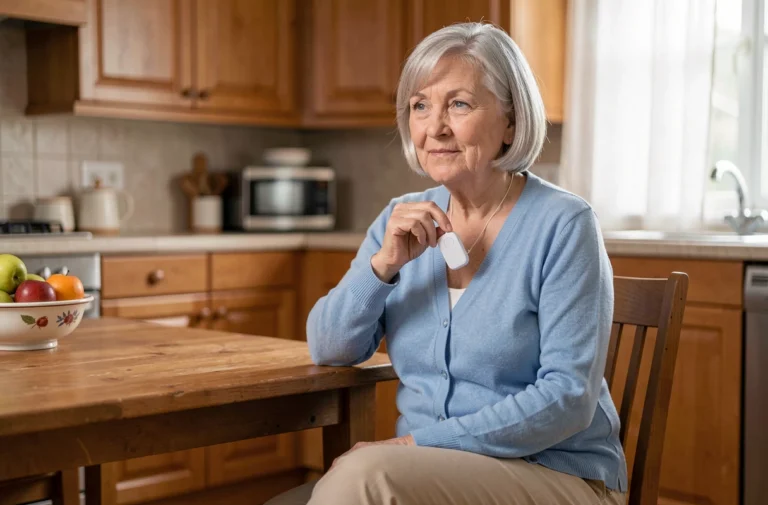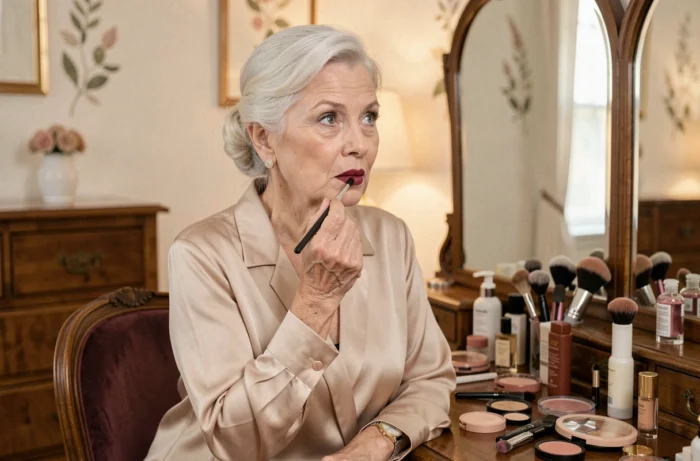
After 70, the texture of the lips changes significantly. The production of collagen and elastin decreases, the contours of the mouth lose definition, and vertical fine lines deepen. A lipstick that worked perfectly ten years earlier may now feather into these lines or accentuate dryness. The choice of lipstick at 70 relies on specific technical criteria that go beyond mere color preference.
Allergens and Microplastics: What a Lipstick Label Really Reveals
A lipstick is a leave-on product applied to a thin mucous membrane. At 70, the lips are often more reactive to chemical components. Reading the INCI list is not a trivial cosmetic reflex; it is a concrete precaution.
Regulation (EU) 2023/1545 has expanded the list of fragrance substances that must be declared individually on the packaging. For a leave-on product, the declaration applies beyond the threshold of 0.001%. In practical terms, a person with sensitive lips can check for the presence of limonene, linalool, or geraniol without relying on the vague mention “fragrance.”
The guide detailing which lipstick to choose at 70 according to Le Sens de la Mode reminds us that matte formulas, once associated with elegance, often cause discomfort on dehydrated lips. Choosing “fragrance-free” is a criterion of tolerance in its own right, distinct from texture or color.
Moreover, Regulation (EU) 2023/2055, which came into effect on October 17, 2023, provides for a gradual restriction on intentionally added microplastics in cosmetics. Lip makeup products benefit from the longest timeline, with a deadline set for 2035. Some texture agents and films may disappear from formulas, which will change the finish and comfort of certain lipsticks in the coming years.
Lipstick Texture on Mature Skin: Matte, Satin, or Tinted Balm
The texture determines the final result much more than the color. On lips marked by fine lines, a matte formula without moisturizing agents sets in a few hours and highlights every crease. Makeup professionals confirm: satin or creamy textures remain the most suitable after 70.
Three families of textures deserve comparison:
- Satin lipsticks leave a light film that reflects light and visually softens fine lines. Their wear is moderate (a few hours), but comfort remains good throughout the day.
- Tinted balms provide a light color and immediate hydration. They are suitable for very dry or fragile lips, but their pigmentation remains subtle.
- Long-lasting matte formulas offer intense pigmentation; however, they dry out the lips and accentuate wrinkles. They require careful preparation (exfoliation, nourishing balm) to limit this effect.
The choice between these textures also depends on the occasion. A tinted balm for everyday use and a more pigmented satin for a special occasion allow for variation without compromising comfort.
Lip Liner and Lip Preparation: Steps That Color Cannot Replace
Applying lipstick directly on unprepared lips ignores half the work. The lip liner plays a technical role that many underestimate after 70.
The liner prevents the color from feathering into the fine lines around the mouth. It creates a physical barrier that contains the pigment. The shade of the liner should match exactly with that of the lipstick, or be slightly lighter. A liner that is too dark creates an artificial outline that hardens the face.
Before applying the liner, a gentle scrub (once a week) removes dead skin that catches color unevenly. A nourishing balm applied a few minutes before makeup softens the surface. These two steps radically change the wear and uniformity of the result.
Applying with a Brush or Directly from the Bullet
A lip brush allows for a more precise application, particularly useful when the natural contour of the mouth has faded. It also controls the amount of product applied. A thin, even layer lasts better than a thick application that accumulates in the creases.
Direct application from the bullet remains quicker and suits creamy formulas or tinted balms, whose soft texture forgives inaccuracies.
Lipstick Shades Suitable After 70: Beyond Nude and Bright Red
A common reflex is to retreat to neutral shades for fear of overdoing it. Very pale nude tones can, however, give a tired appearance by erasing the relief of the mouth. Conversely, a very saturated red on thin lips draws attention to the loss of volume.
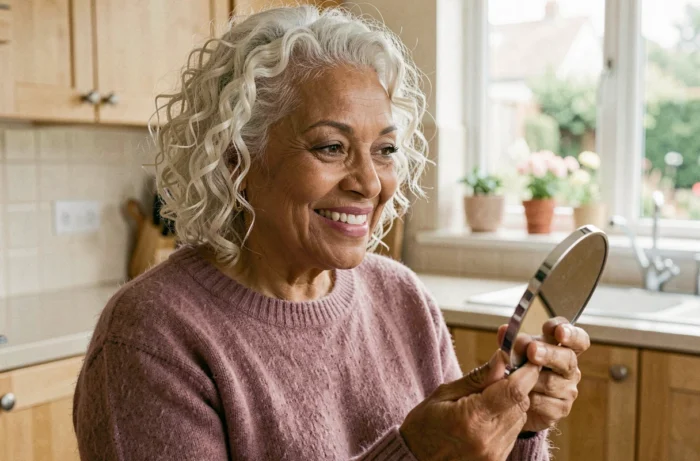
The shades that work best on mature lips share a common point: they contain a hint of warmth. Wooded pinks, brick reds, muted berries, and rosy mauves add color without creating a harsh contrast with the complexion.
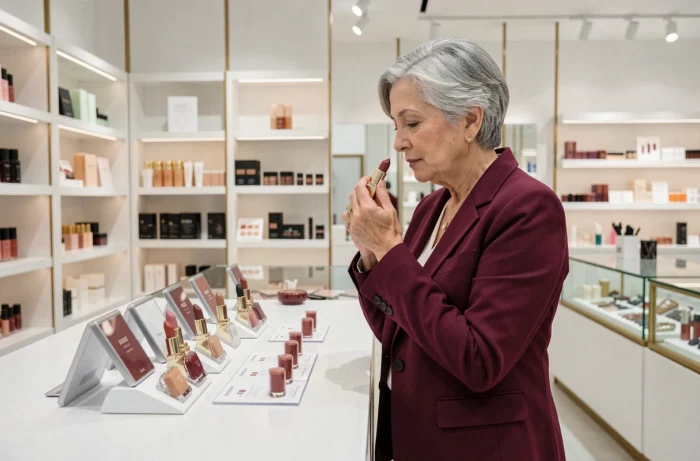
Testing the color on the lower lip, in natural light, remains the only reliable way to judge the result. Samples applied to the hand do not reflect either the natural pigmentation of the lips or their actual texture.
Very saturated cool shades (bright fuchsia, dark plum) may work on certain skin undertones, but they require balanced eye makeup to avoid unbalancing the face. Feedback on this point varies: some women wear deep burgundy with confidence, while others find that the same shade ages them.
Lipstick after 70 does not follow a single rule. Texture takes precedence over color, lip preparation affects wear, and careful reading of the label protects skin that is less forgiving of aggressive formulations. Recent European regulations on allergens and microplastics will gradually change the available offerings, which could simplify sorting for the most reactive skin.