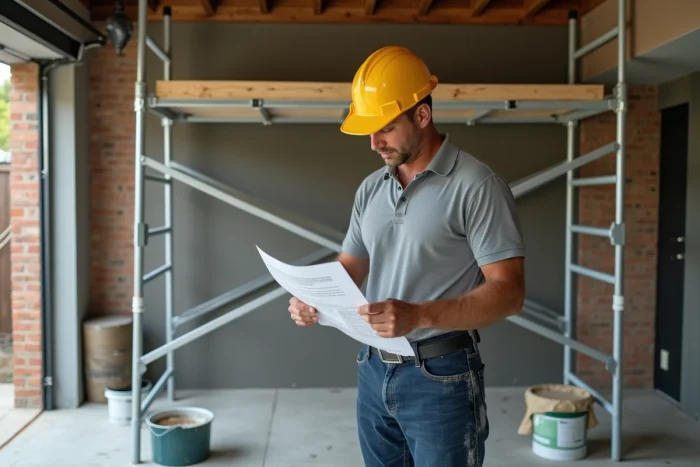
The working height of a scaffold refers to the distance between the ground and the highest point an operator can reach with arms raised from the platform. This data determines the type of structure to rent, its stability, and the safety accessories to consider. Confusing platform height and working height remains the most common mistake when choosing a scaffold for renovation or façade work.
Platform height and working height: two values not to confuse
A scaffold with a specification indicating a platform height of 6.70 m actually offers a working height of about 8.70 m. The difference, generally close to two meters, corresponds to the reach of a person standing with arms extended upwards.
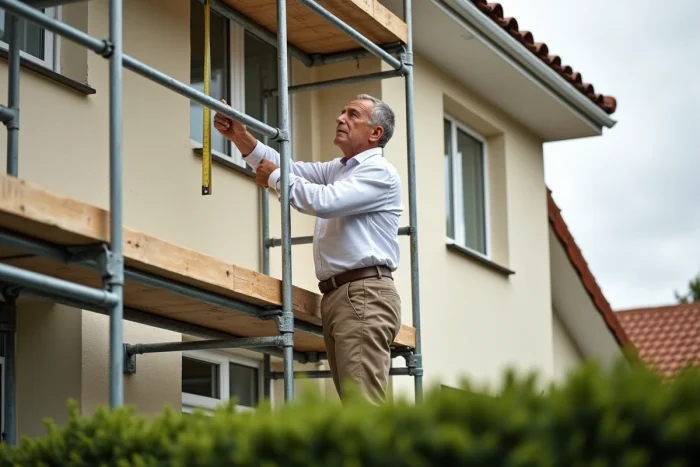
Starting from the area to be reached (ridge, top of gable, underside of gutter) and subtracting these two meters gives the necessary platform height. Measuring the façade in advance with a laser rangefinder or a simple tape measure avoids renting an oversized model or, worse, one that is too low.
The models available at DIY superstores are divided into two categories. Domestic scaffolds cover working heights up to about 6.50 m. Rolling scaffolds made of steel or aluminum go higher, with platforms that can exceed 6.70 m.
If your work involves renovating a single-story or one-story façade, it is possible to rent a scaffold from Leroy Merlin with Concept Déco targeting the domestic range, which is often sufficient and more manageable.

Aluminum or steel rolling scaffold: which material for which height
The material of the frame directly influences the perceived stability and the total weight of the structure. An aluminum rolling scaffold moves easily on a hard surface and is well-suited for indoor work or low façades. However, user feedback on aluminum models sold in DIY stores reports a sensation of swaying beyond 2 to 3 m of platform height, especially when the ground has slight irregularities.
Steel, being heavier, offers a more rigid base as height increases. For platforms above 4 m, a steel frame reduces micro-oscillations that can destabilize an operator. The common compromise is to reserve aluminum for quick interventions under 3 m (ceilings, stairwells) and switch to steel as soon as the façade requires going higher.
Specific case of the stairwell
Working in a stairwell requires a scaffold with legs that can be independently adjusted in height. Domestic models with adjustable jacks allow for compensation of the slope of the steps. The usable height in this case rarely exceeds 3 m, but the difficulty lies in the lateral bulk and the width of the platform, not in the height itself.
Safety accessories and actually usable height
Most content on scaffold rental focuses on the maximum height. They overlook a technical point: the usable height depends on the installed protective accessories. Perimeter guardrails, toe boards, and debris nets modify the available workspace on the platform.
A standard scaffold net in a DIY store covers about 60 m² per panel (common size of 3.07 x 20 m). On a narrow façade, a single panel is sufficient. On a wide gable or corner return, overlaps must be planned, which reduce the net protected area. This calculation determines the length of scaffold to rent and indirectly the optimal height of each element.
- Guardrails are mandatory beyond 2 m of platform height: their presence slightly reduces the accessible working area at the perimeter.
- Toe boards prevent tools and materials from falling: they add weight to the frame elements and must be included in the total sizing.
- Debris nets protect the work environment but require a sufficiently rigid frame to withstand wind resistance, favoring steel models outdoors.
Choosing scaffold height according to the type of façade work
The reasoning always starts from the highest area to be reached, never from the maximum height of the available model. Renting a scaffold too large to repaint a fascia board at 4 m means paying for a heavier structure that takes longer to set up and is bulkier in the garden.
- Painting shutters, cleaning gutters, window joints on the ground floor: a working height of 3 to 4 m is sufficient. A lightweight domestic scaffold meets this need.
- Renovating a one-story façade, external thermal insulation on a raised single-story house: aim for a working height around 5 to 6.50 m. Recent domestic ranges now reach this range, avoiding the need to go through a professional rental service.
- Two-story house gable, chimney, ridge: the working height often exceeds 7 m. A steel rolling scaffold with a platform at 6.70 m then becomes the minimum. Setting up at this height requires checking the load-bearing capacity of the ground and stabilizing the base with plates or braces.
Checks before assembly
Regardless of the chosen model, three points deserve systematic checking before each use. The ground must be level, stable, and not loose (placing distribution plates on soil or gravel). The wheels, if the model is rolling, must be locked throughout the duration of the work at height. The pins or locking clips of the frames must be engaged at each level, without exception.
The current trend in DIY superstores is pushing the heights offered to individuals upwards. Models reaching 6 to 6.50 m of working height are now alongside small 3 m scaffolds on the shelves. This evolution expands the range of work that can be done without going through a specialized rental service, provided that the rules of stability and protection that apply as soon as the platform exceeds 2 m are respected.