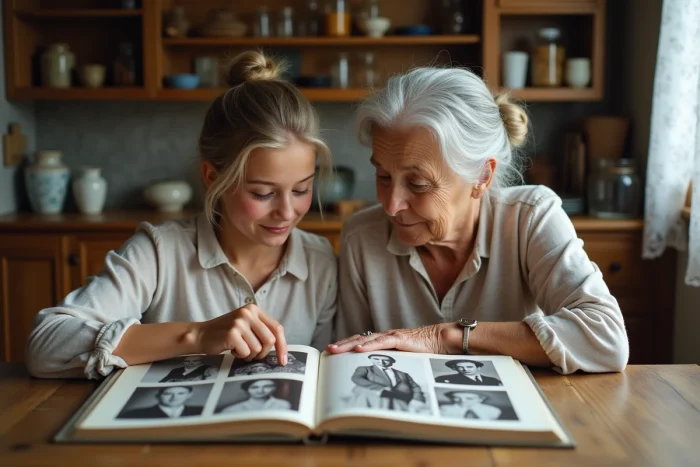
The transmission of family history refers to the collection of stories, objects, and rituals through which a family conveys to future generations the knowledge of its origins, trials, and choices. This transmission is not limited to creating a family tree: it shapes how a child situates themselves in time and within a group. Understanding this mechanism requires examining what family memory concretely produces and why its loss permanently alters the relationship to oneself.
Family Narrative Coherence and Identity Construction in Children
Research in clinical psychology uses the concept of family narrative coherence to describe a family’s ability to connect its life events into a transmissible narrative. When parents or grandparents recount a difficulty overcome, a move, a breakup, or an unexpected success, they are not just sharing an anecdote. They provide a framework that the child can use to interpret their own transitions.
A child who knows that their great-grandfather changed careers after an economic crisis, or that their grandmother learned to read on her own, has a repertoire of possible responses to uncertainty. This knowledge of ancestors and their journeys helps young people better situate their identity and navigate moments of upheaval, whether it be a change of school, a bereavement, or parental separation.
Resources like cultivonsnosracines.fr make this transmission process accessible, even for families that have never formalized their oral heritage.
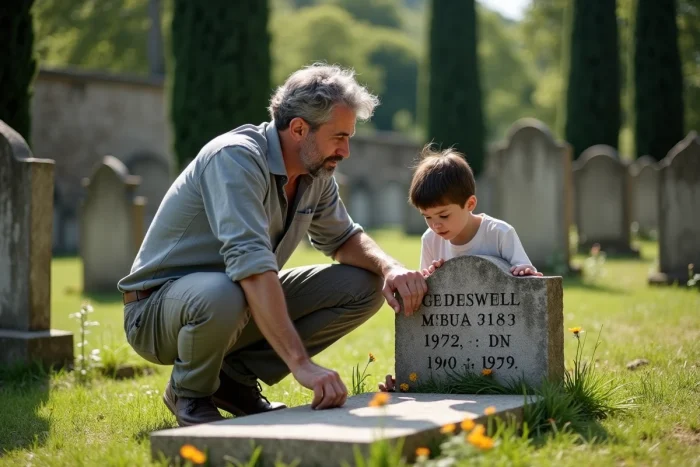
Family Memory and Geographical Dispersion: What Mobility Erases
Articles on family transmission often mention the value of traditions and shared memories. They less frequently address a factor that accelerates memory loss: the geographical dispersion of families.
When three generations live in the same city, transmission occurs through immersion. Children hear stories at the table, recognize mentioned places, and encounter characters from the narrative. When the family is spread across several regions or countries, this channel almost entirely disappears.
Contemporary professional mobility fragments opportunities for prolonged contact between grandparents and grandchildren. Without deliberate effort, life stories stop at the previous generation. A father or mother who grew up far from their own grandparents often has very little to pass on, not out of disinterest, but due to a lack of raw material.
Concrete Consequences on Family Life
This rupture produces measurable effects in daily life. Children who do not know their family’s history ask fewer questions about their origins, not because they are uninterested, but because they do not know there is something to inquire about.
- Family names lose their significance when no one can explain why they were chosen, severing a symbolic thread between generations.
- Culinary traditions, holidays, or seasonal rituals dissolve within one or two generations if no one anchors them in an origin story.
- Photo albums, letters, or inherited objects become silent artifacts, lacking the narrative context to accompany them.
Transmission Supports: Why Voice Matters as Much as Writing
Classic genealogy relies on written documents: civil status records, parish registers, correspondence. This search for archives remains valuable, but it captures only a fraction of family history. The intonations, expressions, and silences of an oral narrative carry an emotional weight that writing cannot convey.
Audio or video recordings of family testimonies are gaining ground as a transmission tool. Filming a grandparent recounting their childhood, successive jobs, or the circumstances of a migration preserves nuances that are impossible to transcribe. The tone of voice, hesitations, and bursts of laughter become memories that can be passed down.
Choosing the Right Format According to Family Context
Not all formats suit all families. An informal audio recording made during a festive meal captures spontaneous exchanges that a filmed interview in front of a camera will not produce. Conversely, a structured interview with prepared questions allows for covering periods or topics that free conversation might have avoided.
- Audio recording works well with individuals who feel intimidated by the camera, and it is easily shared among distant family members.
- Video adds the face, gestures, and living environment, all elements that enrich the narrative for generations who will not have known the witness.
- Writing remains the most durable and easiest format to archive, but it requires a writing effort that many families never undertake.
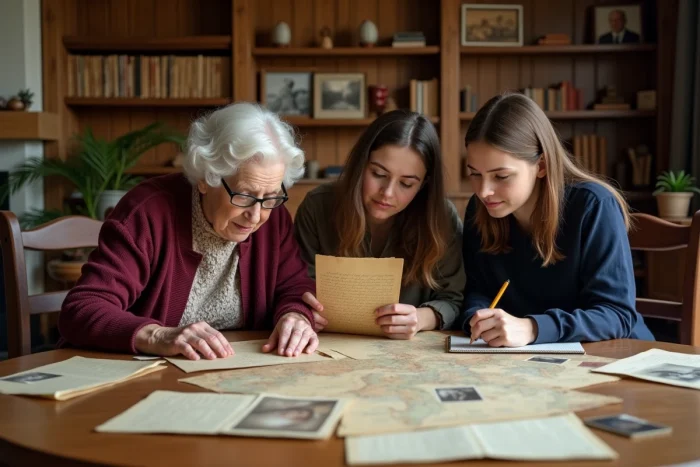
Family Tree and Life Narrative: Two Complementary Approaches
Creating a family tree and telling the family story meet different needs. The family tree establishes facts: names, dates, places, lineages. The life narrative gives meaning to these facts by connecting them through causes, choices, and chance events.
A child who sees the name of an ancestor on a tree knows that they existed. The same child, if they hear why that ancestor left their region or how they met their spouse, understands that their own existence results from a series of concrete decisions. This understanding transforms genealogy into a living heritage.
Combining both approaches produces a stronger outcome. The tree provides structure, the narrative provides substance. Without a narrative, the tree remains a list of names that no one consults after the initial curiosity. Without a tree, the narrative floats without reliable chronological or geographical markers.
The transmission of family history to new generations requires neither special skills nor a budget. It requires time and a clear intention. Each recorded conversation, each annotated album enriches the collective narrative.
What is not transmitted now will disappear with the generation that still carries it.