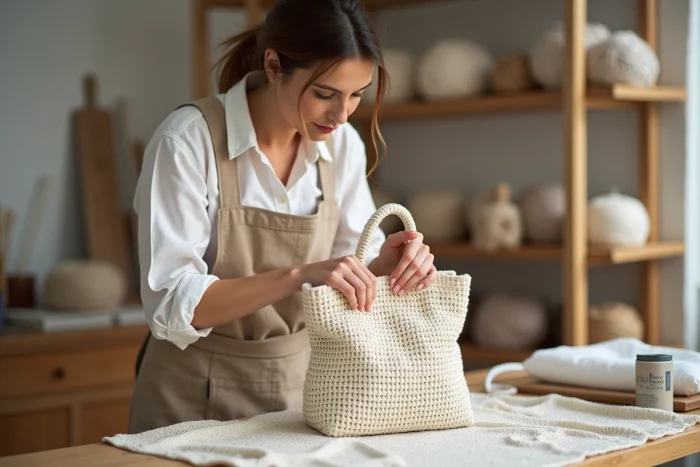
A freshly finished crochet bag often loses its shape as soon as you slip in a wallet or a book. The yarn, by nature flexible, cannot withstand the weight of everyday objects. Rigidifying a crochet bag requires understanding why the stitches deform, and then choosing the right technique based on the yarn used and the desired result.
Why a crochet bag deforms under load
The problem does not stem from a manufacturing defect. Even tightly crocheted stitches leave a gap between each loop. Under the weight of the contents, these micro-spaces stretch and the bag elongates downward.
Natural fibers like mercerized cotton amplify this phenomenon: they slide against each other more easily than a textured synthetic yarn. An open stitch (granny square, mesh) worsens the deformation compared to a tight stitch or a rice stitch.
Before looking for how to rigidify a crochet bag on Allure Mode, it is essential to identify the source of the problem: is it the bottom that sags, the walls that spread apart, or both? The answer leads to very different solutions.
Thermoplastic interfacing on lining: the most durable method to rigidify a bag
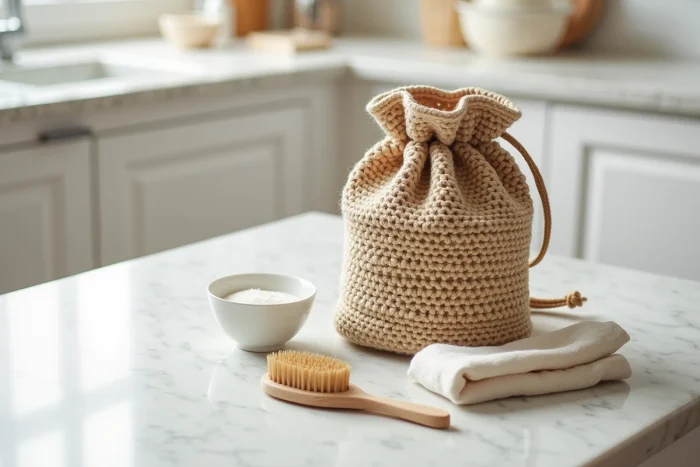
Starch products and hardening sprays frequently appear in online advice. They work temporarily, especially on natural fibers, but disappear after the first wash or under the influence of ambient humidity.
A much more stable alternative is to sew a fabric lining inside the bag, then thermally bond a rigid interfacing before assembly. Non-woven interfacings like Vlieseline H250 provide firm support without adding weight to the piece. The H630, which is softer, adds a slight puffiness suitable for rounded bags.
Why separate the reinforcement from the crochet
Gluing interfacing directly onto the crocheted stitches flattens them and removes their texture. By attaching the fusible interfacing to the cotton or linen lining, the crochet appearance is preserved on the outside while gaining structure on the inside.
The lining can also be removed for separate washing if it is secured with snaps or a basting stitch. The crochet remains flexible on the outside, while the lining maintains the shape on the inside: this combination solves the problem without sacrificing aesthetics.
- Cut the interfacing to the exact dimensions of each panel of the bag (bottom, sides, front, back), removing half a centimeter of margin to avoid puckering at the seams.
- Iron the interfacing onto the reverse side of the fabric lining with a medium iron, pressing without sliding to ensure adhesion.
- Sew the interfaced lining together, then attach it inside the crochet bag with a discreet overlock stitch along the top edge.
Rigid reinforcements for the bottom of the bag: plastic, cardboard, 3D printing
The bottom is the most stressed area. Without specific reinforcement, it takes on a bulging shape as soon as a heavy object is placed on it.
Custom-cut plastic grids
Plastic canvas sheets, sold in craft stores in rectangular format, can be cut with a knife to fit the shape of the bottom. Slipped between the lining and the crochet, they prevent the bottom from bending. Their thickness remains low and the added weight is negligible compared to the gain in stability.
3D printed bottoms: a custom reinforcement
Creators have been sharing files for 3D printed bag bottoms in PLA or PETG on platforms like Printables or Thingiverse for a few years. These pieces are designed with holes aligned with the stitches, allowing for invisible sewing directly through the plastic.
This approach remains marginal in French-speaking tutorials, but it offers a clear advantage: a 3D printed bottom fits exactly the template of the bag, without approximate cutting. PLA is sufficient for everyday use, while PETG withstands heat better if the bag is exposed in a car during summer.
Starch and hardening solutions: limits to know before using them
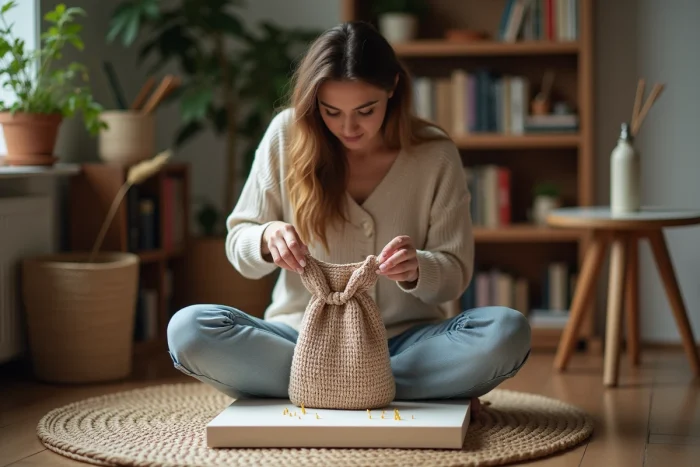
Recipes based on corn starch diluted in water, diluted white glue, or commercial sprays do indeed rigidify the stitches. The principle is simple: the product penetrates the fibers, dries, and forms a film that maintains the shape.
Field feedback varies on the longevity of these treatments. On a decorative bag placed on a shelf, starch lasts several months. On a bag used daily, exposed to hand sweat and friction, the rigidity obtained from starch disappears within a few weeks.
- Corn starch mixed with cold water and then heated creates a thick paste to apply with a brush, effective on cotton and linen.
- Diluted white vinyl glue (about one part glue to one part water) provides a more resistant film, but it alters the feel of the yarn and makes it slightly sticky if the dosage is too strong.
- Commercial textile stiffening sprays are quick to apply, but their effect remains the most superficial of the three options.
On synthetic fibers (acrylic, polyester), starch adheres poorly. Vinyl glue works better, but the result is never as firm as mechanical reinforcement (interfaced lining or rigid bottom).
Choice of crochet stitch and tension: act upstream
Rigidifying a bag after its creation is a corrective measure. The choice of stitch and crochet beforehand limits the need for reinforcement.
A hook half a size smaller than that recommended by the yarn produces a denser stitch. Crocheting tightly reduces the gap between the loops and slows down stretching. The single crochet stitch is the most stable for structured bags. The moss stitch (single crochet in back loop only) creates horizontal ribs that add natural rigidity to the walls.
Multi-strand twisted yarns resist deformation better than strand yarns or ribbons. A tightly twisted combed cotton yarn produces a firmer fabric than a loosely twisted cotton yarn, even at the same gauge.
Combining a tight stitch, suitable yarn, and interfaced lining on the bottom and sides results in a bag that stands upright without support. For creations where openwork is part of the design, mechanical reinforcements (plastic grid, printed bottom) remain the only reliable long-term option.