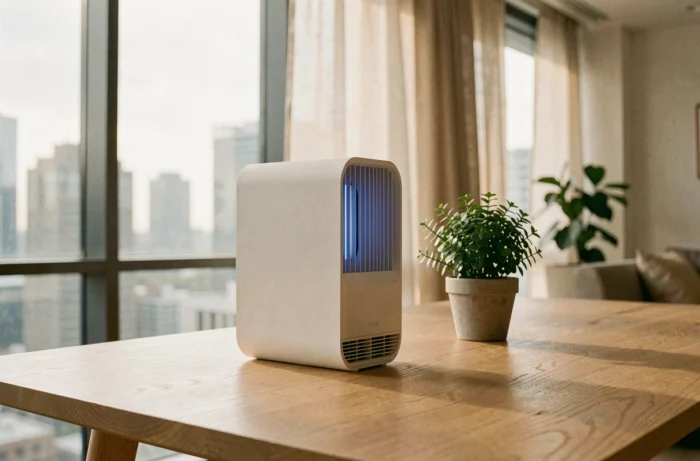
In a city apartment, indoor air concentrates fine particles from road traffic, pollen that enters through partially open windows, and volatile compounds from furniture or household products. Choosing an air ionizer in this context is not just about buying the highest-rated model online: one must first understand what this technology actually does to pollutants and what it does not do.
Air Ionizer in an Apartment: What Really Happens After Ionization
An ionizer emits negative ions that attach to suspended particles. These weighted particles fall onto surfaces (walls, floors, furniture) or settle on collector plates integrated into the device. We often talk about purification, but ionization moves particles more than it destroys them.
In an apartment, this nuance has direct consequences. If surfaces and collector plates are not cleaned regularly, particles will become airborne again at the slightest draft or vacuuming. The actual effectiveness therefore depends as much on the frequency of cleaning as on the power of the device.
Another limitation to keep in mind: ionization does not act on gaseous pollutants. Cooking smells, tobacco, or traffic odors are not solid particles. To address these compounds, an activated carbon filter or effective ventilation is needed. An ionizer alone is not sufficient if you live on a busy boulevard. To delve deeper into this point, the Ionizers guide for an apartment in the city details the combinations of technologies suitable for urban housing.
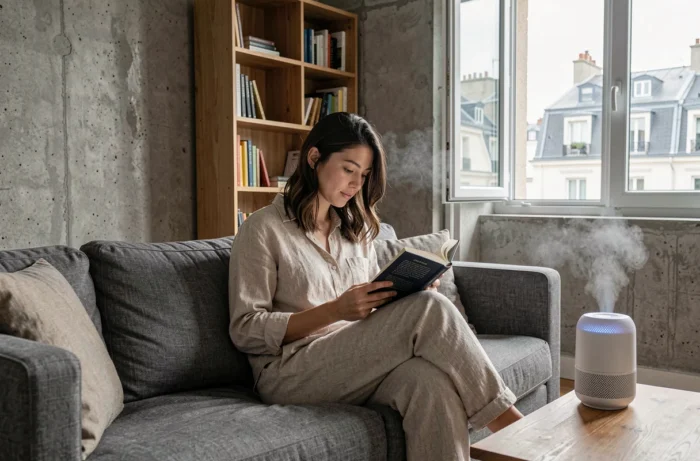
Standalone Ionizer or Ionizer Coupled with a HEPA Filter: Which Device to Choose
On the market, there are two main categories. Pure ionizers, without a mechanical filter, and air purifiers that integrate an ionization function alongside a HEPA filter. For a city apartment, a device combining HEPA filter and ionization covers a much wider spectrum of pollutants.
The HEPA filter mechanically captures fine particles, allergens, and mold spores. Ionization complements this by charging ultrafine particles that sometimes escape the filter. It is this combination that makes a purifier relevant in a home exposed to urban pollution.
A pure ionizer may be suitable in a less exposed room (like a bedroom facing an inner courtyard), provided one is willing to accept frequent maintenance of surfaces. Feedback varies on this point: some users notice a grayish deposit on furniture near the device after a few days.
The Trap of Residual Ozone
Some ionizers produce ozone as a byproduct, even in small quantities. The CARB (California Air Resources Board) certification limits emissions to 0.050 ppm, but this compliance does not guarantee the effectiveness of the purifier or absolute health safety. A CARB certification only proves that ozone remains below a regulatory threshold.
For bipolar ionization, the evidence base is less solid than for mechanical filtration according to the EPA, which considers this technology emerging with limited data under real conditions. If there are young children or respiratory issues, one should prioritize a model with a certified HEPA filter and deactivatable ionization.
Technical Criteria for an Air Ionizer Suitable for a Small Apartment
Before purchasing, check a few parameters that make the difference between a useful device and a noisy gadget that ends up in a closet.
- The CADR (Clean Air Delivery Rate): this is the actual performance indicator. It measures the volume of air filtered per minute. Compare it to the size of the targeted room, not to the maximum surface area advertised (which is often optimistic).
- The noise level in night mode: in a studio or one-bedroom apartment, the device often runs in the bedroom. A model that exceeds a perceptible noise level in minimal mode quickly becomes unusable at night.
- The cost and frequency of filter replacements: a HEPA filter generally needs to be changed every six to twelve months. Include this item in the annual budget, as a saturated filter degrades the device’s performance.
- The presence of air quality sensors: an integrated sensor that automatically adjusts the ventilation speed prevents the device from running at full power all the time, reducing noise and consumption.
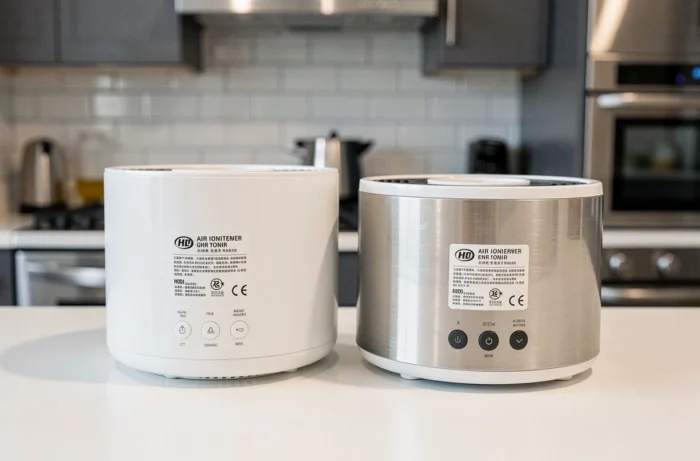
Ionizer and Urban Pollution: Technology Combinations That Work
In the city, pollutants are mixed. We breathe in both fine particles (diesel, braking), volatile organic compounds (VOCs) from furniture and paints, and seasonal allergens. No single technology addresses this entire spectrum.
The most effective combination for an urban apartment includes three elements:
- A HEPA filter to capture fine particles and allergens
- An activated carbon filter to adsorb odors and VOCs from traffic
- An ionization function for ultrafine particles, with an option to deactivate
A purifier without activated carbon allows gaseous pollutants from road traffic to pass through. This is the blind spot of most pure ionizers sold at attractive prices.
Maintenance and Collector Plates
If you opt for a model with collector plates (electrostatic ionizer), cleaning the plates directly affects performance. Dirty plates reduce collection capacity and may promote bacterial growth. Weekly cleaning is recommended to maintain proper functioning.
For a HEPA filter, regular replacement remains the only significant maintenance variable. Some models offer a filter saturation indicator, which prevents operating with a clogged filter without realizing it.
The choice of an air ionizer for a city apartment relies less on the power of ionization than on the device’s ability to handle various pollutants without producing harmful byproducts. A model combining mechanical filtration, activated carbon, and controlled ionization remains the most suitable option for an urban environment.
The final criterion, often overlooked, is the maintenance cost over two or three years: filters, plates, electricity consumption. It is this recurring budget that determines whether the device will still be in service in a year.