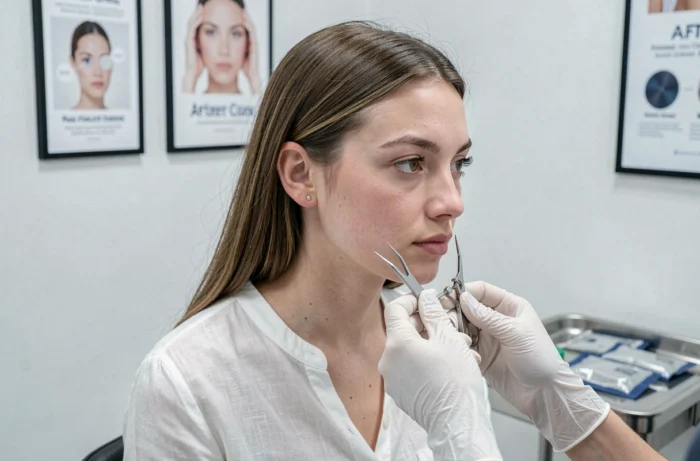
The cartilage ear piercing raises recurring questions, particularly about the existence of an age limit or the actual risks of the procedure. The area in question, whether it is a helix, conch, or rook, traverses a rigid and poorly vascularized structure, which fundamentally distinguishes it from the lobe. This anatomical difference conditions the piercing protocol, healing, and the types of possible complications.
Ear piercing gun and cartilage: what French regulations really allow
The idea that the ear piercing gun is completely banned for cartilage is widely circulated. The regulatory reality is more nuanced. The Public Health Code (articles R.1311-1, R.1311-8, R.1311-9, and R.1311-12) provides an exception for the ear pavilion pierced with a gun, including on cartilage areas.
This exception comes with strict conditions: sterile jewelry in hermetically sealed packaging, single-use protection for the permanent parts of the device, and prior information for the client. Failure to comply with these requirements exposes the professional to sanctions.
Public guides often conflate the lobe and cartilage, which perpetuates confusion. Professional piercers who work with needles recommend avoiding the gun for cartilage, not because the law prohibits it, but because tissue trauma would be more pronounced with a percussion mechanism.
Field reports vary on this point: some professionals observe comparable healing between the two methods when hygiene protocols are followed, while others report more complications with the gun. No large-scale clinical study definitively resolves this.
Untangling the myths surrounding cartilage piercing requires distinguishing what the law states, what practitioners recommend, and what science has actually documented.

Healing of ear cartilage: why age changes the game without being an obstacle
The auricular cartilage does not benefit from direct blood supply comparable to that of soft tissues. Healing relies on the diffusion of nutrients from the perichondrium, the membrane that envelops this structure. This process takes several months, sometimes much longer depending on the exact location of the piercing.
With age, the capacity for tissue regeneration gradually decreases. Healing is slower after 40, but it does occur. The rigidity of cartilage also evolves: in a teenager, the tissue is more flexible and reactive, while mature cartilage is denser and sometimes more brittle under mechanical pressure.
Several factors exacerbate or slow down healing, regardless of age:
- Smoking reduces local microcirculation and delays scar tissue formation, regardless of the type of piercing
- Some chronic conditions (diabetes, autoimmune diseases) disrupt the immune response and increase vulnerability to infections
- Anticoagulant or immunosuppressive treatments alter the initial inflammatory response and coagulation at the piercing site
None of these factors constitute an absolute contraindication, but each justifies a prior discussion with the piercer and, in some cases, medical advice.
Cartilage infection and perichondritis: recognizing signals before complications arise
Perichondritis is the specific complication of cartilage piercing that care guides regularly underestimate. It is an infection of the membrane surrounding the cartilage, often associated with the bacterium Pseudomonas aeruginosa. This germ is resistant to several common antibiotics, making self-medication particularly risky.
If not treated in time, perichondritis can cause a permanent deformation of the ear pavilion. Destroyed cartilage does not regenerate.
Differentiating normal inflammation from an early infection
In the first days following the piercing, local redness, slight swelling, and sensitivity to touch are expected. These signs should gradually decrease. It is the change in the appearance of the symptoms that should raise concern, not their initial presence alone.
- Increased pain after the first week instead of regression indicates an abnormal process
- Redness extending beyond the piercing point and affecting the rest of the pavilion requires prompt consultation
- Yellow-green discharge, marked warmth to the touch, or fever necessitate immediate medical attention
Applying unsuitable antiseptics or removing the jewelry oneself in case of infection can worsen the situation by trapping the infectious focus under the skin. The course of action: consult a doctor who will prescribe, if necessary, an antibiotic targeting Gram-negative germs.
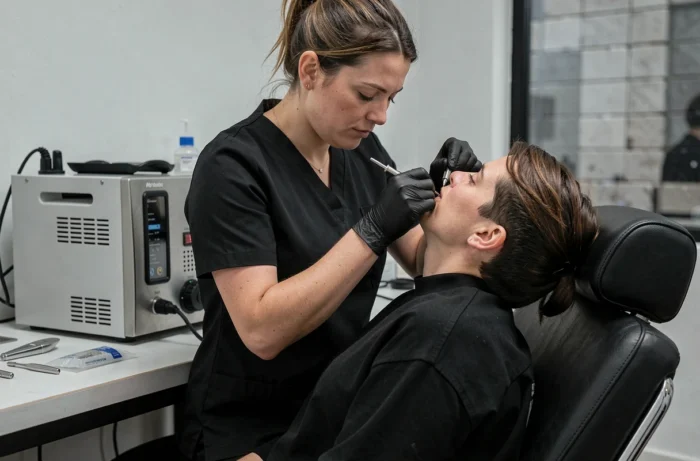
Cartilage piercing for minors: obligation to retain parental authorization
The question of the minimum age for a cartilage piercing frequently arises. In France, piercing a minor requires written parental authorization, including for the ear pavilion done with a gun. This obligation is not limited to the physical presence of a parent on the day of the appointment.
Article R.1311-11 of the Public Health Code requires the professional to retain this written authorization for three years. This retention period aims to protect the piercer in case of disputes, but also to ensure traceability of the act for the minor.
The choice of the material for the initial jewelry deserves special attention for young wearers. Implant-grade titanium (ASTM F-136 standard) remains the reference to limit allergic reactions, as adolescents’ skin is often more reactive to nickel-containing alloys. A titanium labret rather than a ring reduces friction and snagging during the healing phase, which is particularly important in a school or sports environment.
The cartilage ear piercing does not have a biological age limit. The quality of the result depends on adherence to hygiene protocols, the choice of initial jewelry, and especially the wearer’s ability to follow post-piercing care over several months. On this last point, the maturity of the patient likely matters more than their chronological age.